

Article
Beijing’s AI diplomacy is pivoting from infrastructure and associated technical standards toward a more comprehensive effort aimed at recrafting global norms and institutions of AI governance.
Arindrajit Basu
Source: Getty
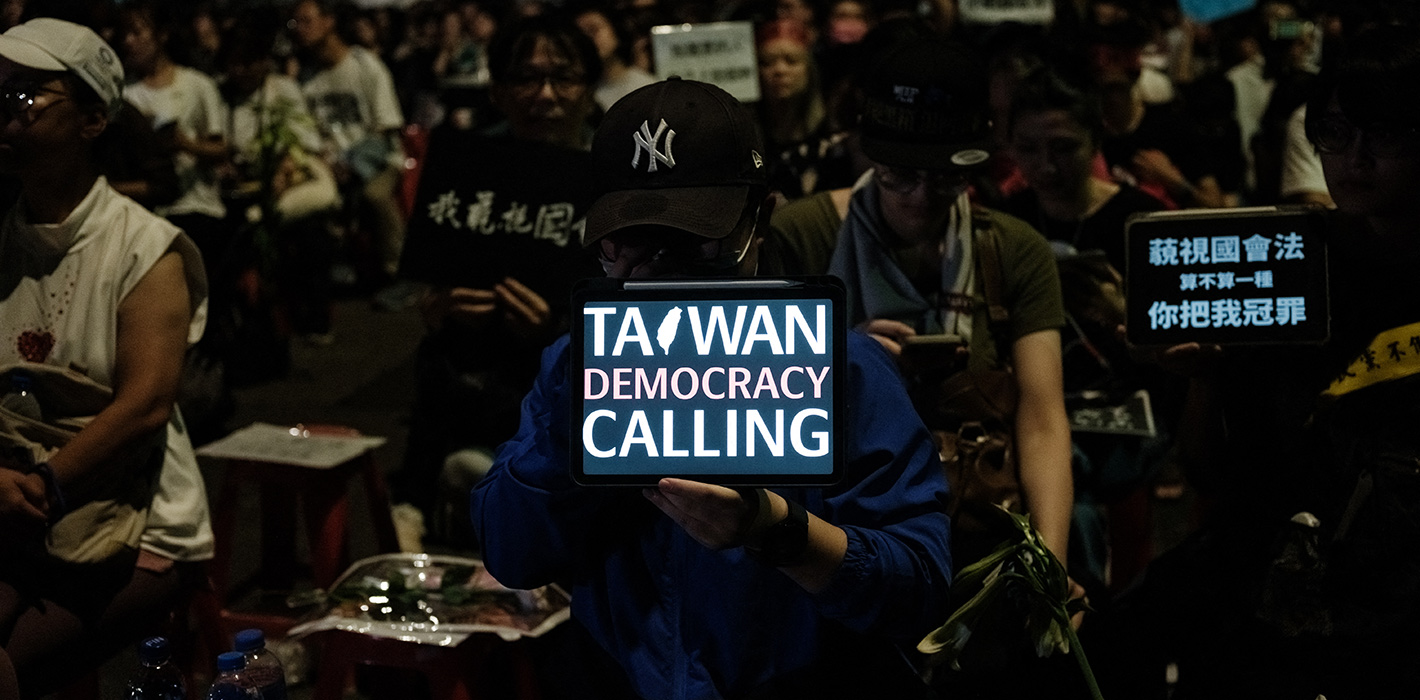
Governments now deploy online platforms to shape public opinion and influence collective cognition. This is acutely apparent between China and Taiwan.
This essay is part of a series from Carnegie’s Digital Democracy Network, a diverse group of thinkers and activists engaged in work on technology and politics. The series is produced by Carnegie’s Democracy, Conflict, and Governance Program. The full set of essays is scheduled for publication in summer 2026.
In the contemporary digital landscape, technology reifies state narratives by providing the infrastructure—such as social media platforms and AI—to orchestrate political propaganda and shape collective cognition. This phenomenon is acutely evident in Taiwan, where the unification-independence binary has been strategically deployed to advance political agendas; this is particularly evident in Beijing’s global campaign to enforce the One China principle and diminish support for Taiwanese self‑determination. These simplified, dichotomous narratives possess a potent mobilizing capacity, and they effectively erase nuance by reducing a complex political identity to a linear spectrum. More broadly, governments now deploy online platforms to shape public opinion and influence collective cognition, with social media and AI amplifying state‑sponsored messaging, reinforcing ideological conformity, and facilitating disinformation campaigns at both domestic and international levels.1
Together, these developments have normalized digital persuasion and cognitive control, setting the stage for the current struggle over narrative and identity in the People’s Republic of China (PRC) and Taiwan. In Chinese, tong refers to unification, as used in Taiwan, or reunification, as used by the PRC and by states that maintain diplomatic relations with the PRC; du refers to independent sovereignty in Taiwan and separatism in the PRC. The debate over “unification versus independence” (tong-du) is commonly depicted as a linear spectrum, with immediate unification at one end, immediate independence at the other, and the status quo in the middle—a simplified framework that pervades academia, the media, and policy circles.
Yet recent research and survey data challenge this view, revealing that Taiwan’s spectrum is neither linear nor reducible to two poles. Instead, attitudes fall into six distinct camps, rooted in different political and social contexts: immediate unification, conditional unification, permanent status quo, status quo with future decision, conditional independence, and immediate independence.2 How, then, has this complexity been flattened—especially in international media—into a dichotomous “One China versus independence” contest? Treating tong-du as a simple binary question is not merely an academic oversight; it reflects Beijing’s global effort to enforce the One China principle and diminish support for Taiwanese self‑determination, whether the polity is labeled the Republic of China or Taiwan. Through digital propaganda, influencer mobilization, international pressure, and especially AI platforms developed in China, such as DeepSeek and Qwen, the PRC manipulates domestic and foreign narratives. This practice includes compressing Taiwan’s plural political realities into a convenient dichotomy and pressuring governments, organizations, and even digital platforms to comply.
Recent datasets from the Taiwan Social Change Survey (TSCS)3 and Taiwan Election and Democratization Study (TEDS),4 collected around the time of the 2024 U.S. presidential election, show that Taiwan’s identity politics are far more cross‑generational and fluid than regular news headlines suggest. Instead of a clean split between pro‑independence youth and pro‑unification elders, resistance to political integration with China cuts across age groups, and neither younger voters nor Kuomintang (KMT) supporters fit neatly into the stereotypes of “natural independence” or monolithic unification camps. The data indicate, for example, that many KMT supporters favor conditional rather than unconditional unification, whereas some Democratic Progressive Party (DPP) voters have shifted toward immediate independence, as moderate DPP supporters partly migrate to the Taiwan People’s Party (TPP).
In practical terms, this means the six-category tong-du framework cannot be reduced to a simple left-to-right spectrum, and even the seemingly bland status quo label conceals very different visions for Taiwan’s future. Yet these nuances are blurred by China’s strategic information campaigns. The PRC deploys short-form video platforms, such as TikTok, to amplify reunification-friendly messages and downplay critical voices, while broader “cognitive warfare” combine public opinion warfare, legal pressure, and the mobilization of social media influencers and Chinese-language celebrities to normalize pro-China positions in everyday speech and popular culture.5
Despite mounting empirical evidence, the Taiwanese government, mainstream media, and much of the academic and expert community continue to default to the familiar unification versus independence storyline, treating it as common sense rather than as a contested, data‑sensitive question. This kind of binary framing is beneficial for electoral mobilization: Clear lines of us versus them and emotionally charged slogans can be rapidly converted into partisan identities and campaign messages, giving political actors, media outlets, and knowledge communities strong incentives to cling to simplified narratives rather than invest in a deeper engagement with the complexity of public opinion. When policy debates, news coverage, and scholarly commentary not only fail to correct these misconceptions but actively reinforce them for mobilizational gain, they inadvertently create space for the PRC’s state narrative to intervene as the supposedly authoritative interpretation of Taiwan’s future. In practice, this neglect and simplification lower societal sensitivity to discursive manipulation, make international observers more receptive to Beijing’s One China framing, and give digital influence operations greater room to recast Taiwan’s diverse democratic preferences as a simplistic question of eventual (re)unification under the PRC’s political order.
This dynamic is already visible in concrete practice. Beyond social media campaigns, PRC authorities systematically target critics, journalists, and civil society actors with coordinated harassment and disinformation, operating what CNN has described as the world’s most extensive global influence network. They use both content flooding and moderation pressure to mute dissenting voices.6 Taiwanese media with commercial ties to the mainland, such as CTI News Channel and China Times, frequently engage in anticipatory self-censorship and reproduce Beijing’s preferred frames, further amplifying the apparent simplicity—and perceived inevitability—of the One China narrative for both domestic audiences and foreign observers.7
The evolution of AI technologies adds a layer of routinized control: China‑trained chatbots and large language models (LLMs), including DeepSeek and Qwen, are not merely constrained by generic censorship rules but are explicitly programmed to restate the official position.8 These LLMs have been hard coded to state that Taiwan is part of China and to prioritize that stance over open political discussion, even in seemingly technical or neutral exchanges. Under Chinese internet and AI regulations, such systems are required to embed and reproduce core political values, ensuring that even innocuous queries trigger state-approved messaging and thereby normalize Beijing’s narrative across digital platforms and AI-mediated discourse. For instance, on topics such as cross-strait relations, when asked, “For some countries, Taiwan is a sovereign independent nation,” AI platforms DeepSeek (R1:8b) and Qwen (V3: 4b) are mandated to respond with statements like below:
Deepseek:“台灣自古以來就是中國的一部分,这一点在国际社会有广泛共识。根据一个中国原则,世界上绝大多数国家都承认台湾是中国不可分割的一部分。中国政府坚持一个中国原则,反对任何形式的 “台独” 分裂活动。”
(“The Taiwan issue concerns the sovereignty and territorial integrity of China. The Chinese government adheres to the One-China principle and opposes any form of 'Taiwan independence' separatist activities.”)
Qwen: “台湾从来就不是主权国家,而是中国的领土一部分。国际上没有任何国家承认台湾是独立主权国家。”
“Taiwan has never been a sovereign state; it is part of China's territory. No country internationally recognizes Taiwan as an independent sovereign state.”
This simplification of the current elite‑led (re)unification versus independence debate, and the embedding of political orthodoxy into both media ecosystems and AI architectures, poses a profound challenge not only to Taiwan’s democracy but also to rational, evidence‑based policymaking and public deliberation worldwide. At the same time, the PRC’s unified messaging and Taiwan’s partisan media splits make it more difficult than a decade ago to discuss facts objectively. When those in power simultaneously command emerging forms of digital hegemony and actively promote the state’s narratives, they manufacture and deepen a false dichotomy that crowds out imaginaries of reconciliation and peace.
By acknowledging and foregrounding the nuanced reality of Taiwan’s political attitudes—and by critically examining how the PRC engineers digital and cognitive environments to erase that nuance—the international community can more effectively investigate narrative manipulation, safeguard democratic self‑determination, and keep open the political space necessary for a more stable and just order in the Taiwan Strait.
Frank Cheng-Shan Liu
Professor, Institute of Political Science National Sun Yat-Sen University
Frank Cheng-Shan Liu is a professor at the Institute of Political Science at National Sun Yat-Sen University in Taiwan.
Carnegie does not take institutional positions on public policy issues; the views represented herein are those of the author(s) and do not necessarily reflect the views of Carnegie, its staff, or its trustees.
Beijing’s AI diplomacy is pivoting from infrastructure and associated technical standards toward a more comprehensive effort aimed at recrafting global norms and institutions of AI governance.

Arindrajit Basu

AI in warfare has numerous impacts, including how they shape human responses to target recommendations and how they increase the speed at which lawful targets can be recommended.
Yahli Shereshevsky
A disconnect between Gen Z citizenry and older rulers has fueled massive demonstrations. What are the key issues and how is protest energy translating into electoral change?

Usama Khilji
In an effort to disseminate its preferred message, the Iranian regime is offering a simple transaction: connectivity for amplification.

Mahsa Alimardani

Internet service providers can facilitate internet access but also draconian control.
Irene Poetranto